|
|
| ENERGY STAR VERSION 2.5 AND 3.0 SUMMARY |
| |
 These
are not all of the requirements, but this is a quick list of the
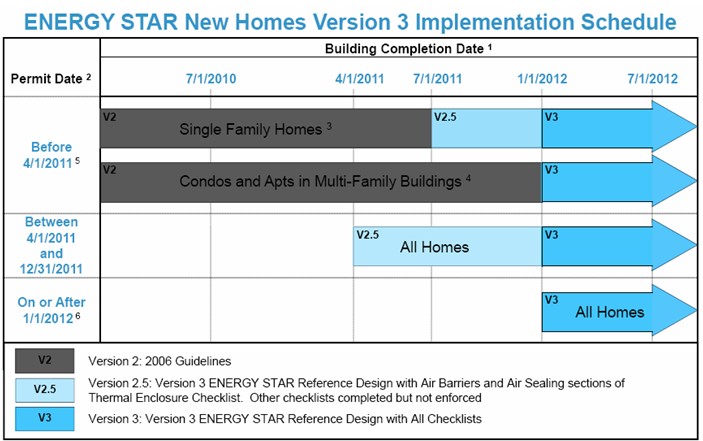
highlights. The Yellow
highlighted areas are those which are
required for Version 2.5 for homes permitted after April 1, 2011 and
completed by December 31, 2011. Homes permitted after January 1,
2012 must meet all of the new requirements. For the full list of new
program requirements and clarifications, go to the E-Library page
and see the section for Energy Codes where you can download copies
of the new guidelines. These
are not all of the requirements, but this is a quick list of the
highlights. The Yellow
highlighted areas are those which are
required for Version 2.5 for homes permitted after April 1, 2011 and
completed by December 31, 2011. Homes permitted after January 1,
2012 must meet all of the new requirements. For the full list of new
program requirements and clarifications, go to the E-Library page
and see the section for Energy Codes where you can download copies
of the new guidelines. |
 |
| NEW HERS INDEX TARGET:
Building Envelope Insulation R-values are
modeled using the IECC 2009, so while
these insulation levels can be
traded off, the reference home uses the following values for
calculating the new HERS Target threshold. |
| Windows |
U-.35 or lower |
| Walls |
R-20 (2x6) or R-13 + R-5 (2x4) |
| Ceilings |
R-38 (or R-30 if you can achieve R-30 over the top
plates) |
| Framed Floors |
R-30 |
| Found. Walls |
R-10 continuous (interior or exterior) or R-13 cavities.
No class 1 vapor barriers allowed! |
|
| Changed definition of conditioned floor area to exclude some
basements! If the basement is finished it is included (and has
always been). If the basement is unfinished, but has supply duct
terminations, it is conditioned space. If the basement is unfinished
and has no supply ducts, it is unconditioned. This is important
because duct leakage maximums under the old method allowed for a
greater square footage allowance for leakage. |
| Square footage penalty for
3BR homes over 2200 ft, and 4BR homes
over 2800. This penalty called the “square footage adjustment
factor” amounts to a slight lowering of the HERS score required to
meet ENERGY STAR |
|
New Checklists |
There are now four checklists to be completed for each
home. The checklists are required to be completed, but the
only one enforced is the Thermal Enclosure checklist.
NOTE: Version 2.5 (Homes permitted after April 1 and
completed by December 31) requires that all the checklists
be completed, but the only one to which compliance is
required is the Thermal Enclosure Checklist. |
| Tighter Duct
Leakage |
Less than 4 cfm of leakage to outdoors per 100 square
foot of conditioned space
Less than 6 cfm of TOTAL leakage (inside and outside) per
100 square feet |
| Tighter Blower
door #s |
Homes must be tighter than 4 ACH 50, our “rule of thumb”
about our blower door number needing to be about 50% of our
above grade square footage is now the official rule. |
|
Square ft |
CFM @ 50 |
| 1000 |
533 |
| 1500 |
800 |
| 2000 |
1067 |
| 2500 |
1333 |
| 3000 |
1600 |
| 3500 |
1867 |
| 4000 |
2133 |
|
|
| Water heaters MUST be Power Vent with minimum EF of .61 for 40
Gallons, .59 for 50 Gallons |
| Programmable thermostats are required, if the system is
geo-thermal, T-stat must be “adaptive recovery” |
Sheetrock must be sealed at the top plates with caulk or foam
(CONSTRUCTION ADHESIVE SHALL NOT BE USED!) at the attic/wall
interface. Apply sealant directly between sheetrock and top plate or
to the seam between the two from the attic above
|
Other Items
- Rough openings around windows and doors sealed with caulk or
foam (not fiberglass chinking!)
- Attic access panels must have durable R-10 or higher
insulation adhered to the cover
- A duct may run on an exterior wall only if a minimum R-6
insulation is provided on the exterior side
- Duct boots must be sealed to floor, wall, or ceiling using
caulk, foam, mastic tape or paste
- No sharp bends or kinks in ductwork, also no excessive
coiled or looped flex-duct
- Kitchen exhaust fan (ducted to exterior) with minimum 100
CFM required (to be tested by Rater)
- Bath Fan with minimum 50 CFM (full baths only) (to be tested
by the Rater)
- MERV 6 or higher furnace filter
- Automatic Mechanical ventilation is now REQUIRED
|
|
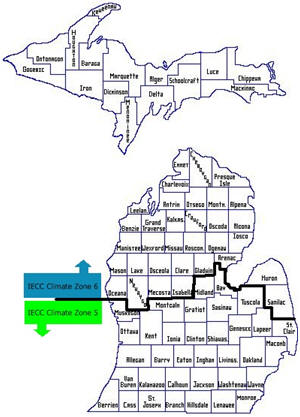
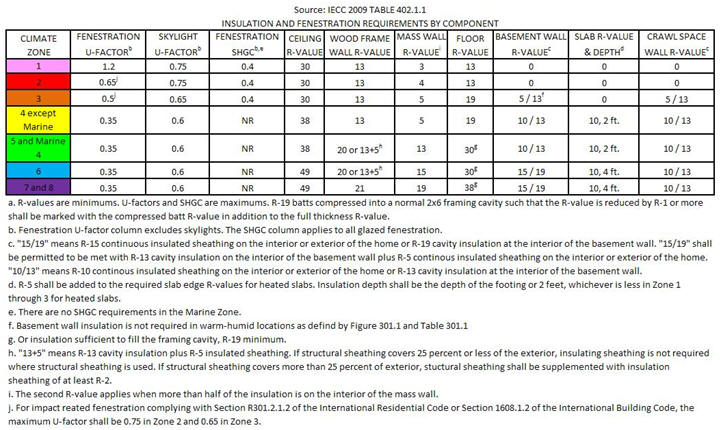
| Michigan is divided into TWO climate zones for the IECC, below
is a map which shows where the line is drawn between Zone 5 and Zone
6. It is important to remember that your home is being compared to a
reference home which has insulation levels EQUAL to those prescribed
in the IECC so while there is a trade-off allowance for insulation
levels in ceilings, walls, floors, and slabs, the overall UA
(U-factor overall) is being compared to the home which has these
higher R-values. |
 |
|
|
|
Calls us at
(517) 712-7665 |
|
Website by ABC Web
Design, LLC. |
